
Email Id: sale@adctooling.com
Choosing among the 2026 top Girder Cranes requires more than comparing lifting capacity and purchase price. A crane that performs well in a steel workshop may be unsuitable for a warehouse with limited headroom. The correct choice depends on load weight, span, lifting height, duty class, travel distance, floor conditions, and operating frequency. Even a small mismatch can cause slower handling, higher maintenance costs, or unsafe loading patterns.
This guide examines single-girder, double-girder, overhead, and gantry crane configurations. It explains where each type works best and where its limitations become visible. Single-girder cranes often suit lighter workloads and moderate spans. Double-girder designs provide greater rigidity for heavier loads and longer spans. Gantry options can reduce building modifications, especially in open yards or temporary work areas. Real project experience shows that installation space matters as much as rated capacity.
Reliable selection should begin with verified load charts, structural calculations, and the manufacturer’s technical documentation. Buyers should also review brake systems, hoist speed, pendant or radio controls, runway alignment, emergency stops, and spare-parts support. Independent inspections and trained operators remain essential after installation. No single model is best for every facility. That sounds obvious, yet rushed purchases still overlook power supply, future expansion, or local service access. This guide offers practical comparisons, but every final decision should be checked by a qualified crane engineer and adjusted to the site’s actual conditions.
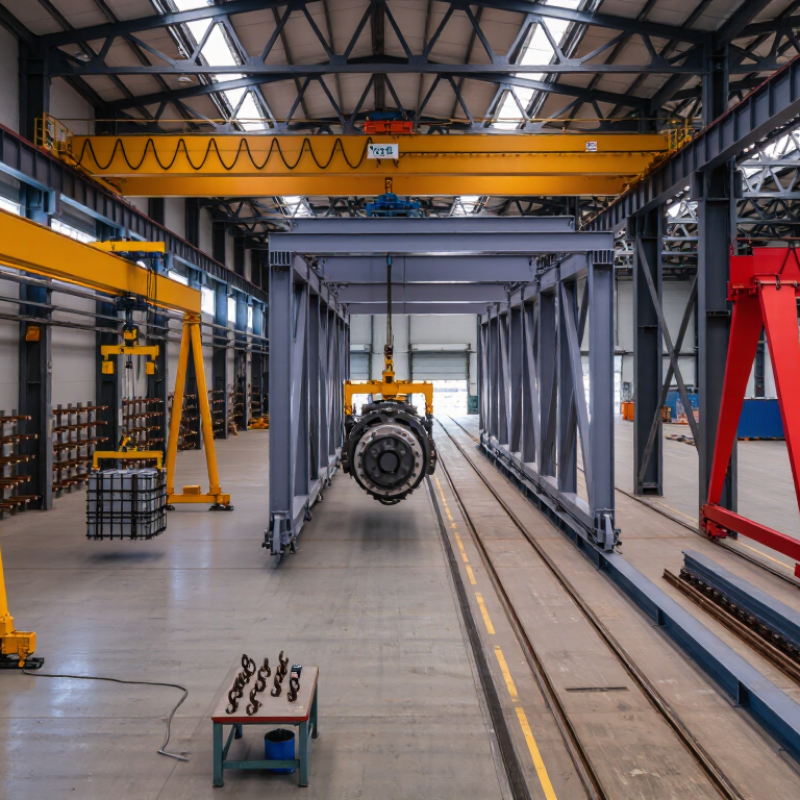
Choosing a girder crane requires more than comparing rated capacity. Single-girder cranes usually suit workshops, warehouses, and moderate lifting duties. They use less steel, reduce dead weight, and often need simpler runway support. Their lower profile can improve hook height, especially beneath a crowded roof. However, their practical capacity and span may limit future expansion.
Headroom matters.
Under a low roof, every millimeter affects loading efficiency. Double-girder cranes use two main beams and generally support heavier loads across longer spans. Their top-running trolley can provide better hook height and improved stability during demanding lifts. This design may suit steel handling, machinery installation, or frequent high-capacity work. Yet the heavier structure requires stronger columns and can increase installation and maintenance costs.
Span alone should not decide the purchase. Measure the runway length, building width, roof clearance, and obstruction points. Include columns, lighting, sprinkler pipes, and service platforms. Load charts should reflect the actual duty class and lifting frequency, not an ideal test condition. A crane lifting five tonnes occasionally faces different stress than one moving four tonnes every few minutes. A careful choice is rarely perfect. Sometimes the cheaper option becomes expensive after clearance problems appear. Review drawings with a qualified engineer, and verify braking, controls, inspection access, and overload protection before ordering.
Choosing among top girder crane types starts with the building, not the catalog. Single- and double-girder versions can use either runway arrangement. Top-running cranes travel on rails mounted above runway beams. They usually support higher capacities and wider spans for demanding production areas. However, their beams, columns, and rail elevations consume valuable headroom. A practical survey records hook height, roof obstructions, bay width, and maintenance access. Measure twice.
Under-running cranes roll beneath runway beams, often using the existing roof structure. This arrangement can preserve floor-to-hook clearance and reduce interference with lights, ducts, and sprinklers. Its limitation is structural. The supporting flange and roof framing must carry concentrated wheel loads. An engineer should verify vertical reactions, horizontal forces, impact allowance, and beam deflection. Do not estimate from lifting capacity alone. A ten-ton crane may create surprising wheel loads near the end truck.
Compare both designs using actual runway data, not only rated tonnage. Check wheel loads at maximum trolley position, rail alignment, span, and duty class. Top-running layouts often suit new steelwork and heavier service. Under-running layouts can fit retrofits where headroom and columns are restricted. Still, “lower cost” is not guaranteed. Roof reinforcement can change the decision. A clean layout can fail review when access platforms are ignored. Leave room for inspection, sway, and future load changes.
Top-running cranes generally provide greater lifting height and higher runway capacity, while under-running cranes can reduce headroom requirements and impose lower wheel loads on the building structure. The chart shows representative engineering values for common industrial crane capacities; final dimensions and reactions must be verified from the selected crane design, span, duty class, and building structure.
Capacity is only the visible number. Duty class reveals the real workload. CMAA Specification No. 70 classifies cranes from A to F, considering operating frequency, load spectrum, and expected service. FEM 9.511 uses groups from 1Am to 5m. It also evaluates working time and average loading. A 10-ton crane lifting twice hourly may need less duty than a 5-ton crane cycling every few minutes. This seems obvious. Yet many buyers still compare rated capacity alone.
Use recorded work cycles as your strongest evidence. Track lifts per shift, average load percentage, trolley travel, starts, stops, and annual operating hours. ISO 4301-1 separates utilization into ten classes, U0 to U9, and load spectra into four classes, Q1 to Q4. These figures help engineers assess fatigue more realistically. However, CMAA and FEM classifications are not always directly interchangeable. A qualified designer should confirm the mapping.
Tips: Build a twelve-month duty profile before requesting quotations. Include peak loads, idle periods, and seasonal changes. A neat spreadsheet can still mislead. Operators may handle loads differently during urgent production. Review maintenance logs and observe one typical shift. Then select the girder crane structure, hoist, controls, and braking system around the verified class, not the largest headline capacity.
Choosing a girder crane starts with the working environment, not the catalog. Single-girder cranes often suit lighter loads and moderate spans. Double-girder designs provide greater lifting height and stiffness. Top-running and under-running systems also require different runway assessments.
For U.S. operations, ASME B30.2 provides guidance for overhead and gantry crane operation, inspection, maintenance, and safety devices. OSHA 1910.179 establishes workplace requirements for rated loads, guards, brakes, controls, inspections, and operator practices. These documents are related, but they are not identical. A qualified engineer should confirm which requirements apply to the site.
In Europe, EN 15011 addresses bridge and gantry crane design, verification, safety functions, and operating conditions. Check load combinations, limit switches, emergency stops, hook latches, access points, and runway deflection. A visible load plate helps, but it cannot replace training or inspection records. Small details matter.
No standard is a magic shield. A checklist can still miss a damaged festoon cable or a crane drifting after braking. Operators should report unusual noise, sway, or delayed stopping immediately. The selected crane must match duty class, span, lift height, temperature, and maintenance capability. Local laws may add requirements, so a competent person should review the final design before installation.
2026 Top Girder Cranes Types: How to Choose the Best One?
Selecting a girder crane starts with the real load, not an estimated average. Record the heaviest item, lifting frequency, span, and required hook height. Single-girder cranes suit moderate loads and simpler workshops. Double-girder models offer greater capacity, stiffness, and lifting height for demanding operations. A crane rated for 10 tons should not routinely handle 10 tons. Leave a practical safety margin.
Duty cycle strongly affects the choice. Occasional lifting may need less equipment than continuous production work. Check lifting speed, trolley travel speed, and bridge travel speed against your workflow. Faster movement is useful, but abrupt acceleration can increase load swing and structural stress. Maintenance access also matters. Choose accessible electrical panels, visible ropes, replaceable wear parts, and clear inspection points. A reliable maintenance schedule is often more valuable than a higher top speed.
Tips: Compare total cost over the crane’s working life. Include installation, electricity, inspections, spare parts, downtime, and operator training. Ask for duty classification, test records, load charts, and maintenance guidance. The lowest purchase price can become expensive after repeated repairs. There is no perfect crane. Recheck your assumptions with actual production data, because early estimates are often incomplete.
| Girder Crane Type | Typical Capacity | Typical Span | Recommended Duty Cycle | Typical Hoisting Speed | Maintenance Profile | Relative Initial Cost | Best-Fit Applications |
|---|---|---|---|---|---|---|---|
| Single-Girder Top-Running Overhead Crane | 1–20 metric tons | Up to approximately 30 m | FEM 2m–3m ISO M5–M6 Light to moderately repetitive service | Approximately 3–8 m/min for standard lifting; higher speeds may be specified for selected applications | Low Simple structure, fewer wheels and components, generally easy access for routine inspection | Low | General manufacturing, workshops, warehouses, maintenance bays, and material handling with moderate utilization |
| Double-Girder Top-Running Overhead Crane | 10–500 metric tons or more, subject to engineering design | Approximately 10–40 m or more | FEM 3m–5m ISO M6–M8 Heavy, frequent, or continuous-duty service | Approximately 2–12 m/min for lifting; separate higher-speed travel drives are commonly available | Medium More wheels, end trucks, girders, and electrical components require a larger inspection and service program | High | Steel processing, foundries, heavy fabrication, power facilities, shipyards, and high-capacity production lines |
| Underhung Single-Girder Crane | Typically 0.5–10 metric tons | Approximately 6–25 m, depending on building structure | FEM 1Am–3m ISO M4–M6 Light to moderate duty | Approximately 3–8 m/min for standard lifting | Low to Medium Can use existing roof-supported runway systems, but runway alignment and building connections require regular attention | Medium | Facilities with limited floor space, low-headroom areas, assembly lines, machine shops, and buildings where floor columns should be minimized |
| Low-Headroom Single-Girder Crane | 1–10 metric tons | Approximately 8–25 m | FEM 2m–3m ISO M5–M6 Moderate production and maintenance work | Approximately 3–8 m/min for lifting | Low Compact hoist arrangement improves available lift height; standard wear parts are generally accessible | Medium | Workshops, warehouses, HVAC or equipment installation, and applications requiring maximum hook height under existing roof constraints |
| Process Double-Girder Crane with Auxiliary Hoist | 10–250 metric tons main hoist; auxiliary hoist commonly 5–20% of main capacity | Approximately 12–35 m | FEM 4m–5m ISO M7–M8 High-cycle process operation | Approximately 1–10 m/min for main lifting; auxiliary hoist speed is commonly higher | High Requires scheduled inspections for brakes, ropes, sheaves, drives, controls, load-monitoring systems, and safety devices | Very High | Continuous production, billet or coil handling, heavy assembly, controlled-positioning operations, and applications needing two lifting capacities |
| Explosion-Protected Girder Crane | 1–50 metric tons, depending on hazardous-area classification and design | Approximately 8–30 m | FEM 2m–4m ISO M5–M7 Duty must match the hazardous-area assessment | Approximately 1–6 m/min for controlled lifting and positioning | High Specialized electrical equipment, grounding, braking, inspection, and certification requirements increase maintenance effort | High | Paint facilities, chemical plants, gas-related areas, fuel handling, and other locations requiring explosion-protected equipment |
| Outdoor Double-Girder Gantry Crane | 10–500 metric tons or more, subject to site and structural design | Approximately 10–40 m; leg height is project-specific | FEM 2m–5m ISO M5–M8 Intermittent outdoor handling to heavy process service | Approximately 2–10 m/min for lifting; long-travel speed commonly selected around 20–40 m/min | Medium to High Outdoor exposure adds inspection needs for corrosion protection, rails, storm anchoring, wheels, electrical enclosures, and drainage | High | Outdoor yards, precast concrete plants, shipbuilding areas, steel stockyards, construction sites, and locations without a suitable building runway |
Selection guidance: Capacity should be based on the maximum lifted load, lifting attachments, impact factors, and required safety margins. Duty classification should be calculated from load spectrum, operating time, starts per hour, and average load—not from capacity alone. Speeds shown are typical planning ranges; the final values must be confirmed by a crane engineer after reviewing the building structure, runway, headroom, controls, environmental conditions, and applicable local standards.