China Best Wall Mounted Battery Harness Supplier?
Choosing the China best Wall Mounted Battery Harness supplier requires more than comparing prices. It demands careful attention to safety, compatibility, workmanship, and long-term service. A reliable supplier should understand battery storage systems, wall-mounted installation limits, connector design, and cable management. These details influence charging stability and maintenance efficiency.
An experienced manufacturer can explain conductor materials, insulation ratings, terminal quality, bending radius, and temperature performance. Ask for production samples, test records, traceability information, and clear technical drawings. A dependable Wall Mounted Battery Harness should fit the battery enclosure accurately, remain secure during vibration, and resist heat near charging components. Factory audits can also reveal practical details, such as crimping controls, labeling methods, and inspection routines. Small signs matter.
However, no supplier is perfect. Specifications may change, samples may perform differently, or communication may become slow after an order. That possibility deserves honest attention. Request a pre-production sample and confirm every critical dimension before mass manufacturing. Independent testing may provide additional confidence, especially for high-current applications. The best partnership combines engineering knowledge with transparent communication, consistent quality control, and responsive after-sales support. Look beyond polished claims. A supplier’s real experience appears in its questions, records, and willingness to improve. This approach helps buyers select a China-based Wall Mounted Battery Harness supplier with stronger reliability and fewer surprises.
What Is a Wall-Mounted Battery Harness? 48–51.2 V LiFePO₄ Systems
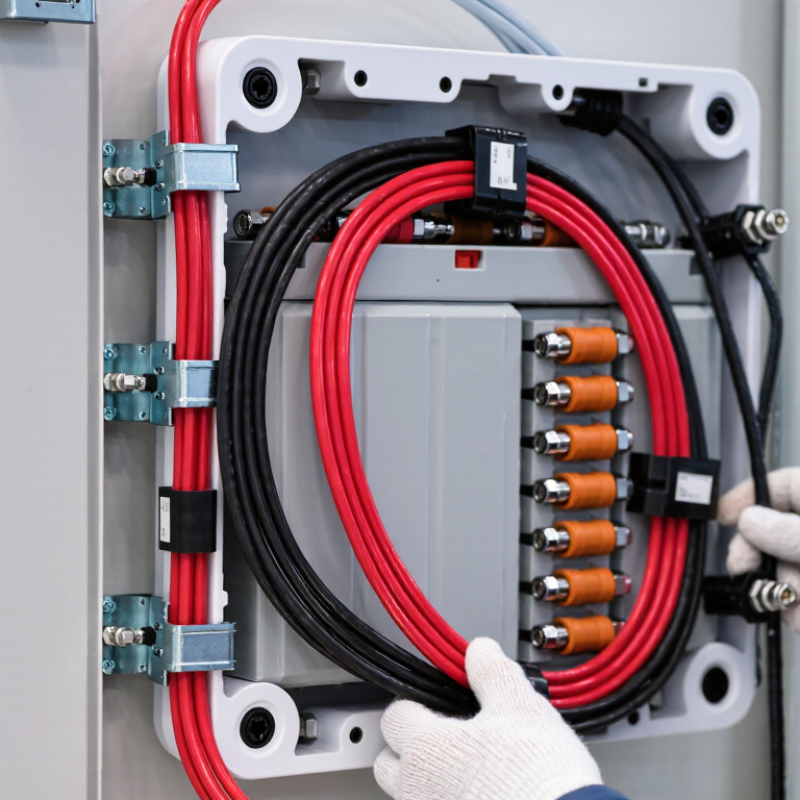
A wall-mounted battery harness connects a LiFePO₄ battery to an inverter, charger, and protection devices. In 48–51.2 V systems, it usually includes power cables, communication wires, terminals, fuses, and grounding points. A 51.2 V battery commonly uses sixteen series-connected cells, while 48 V describes the nominal system range.
Practical installation checks show that cable length matters. Short, correctly sized conductors reduce voltage drop and unnecessary heat. The harness should use flexible insulation, secure crimping, and connectors rated for the system’s current. Keep positive and negative cables separated where practical. Add strain relief near the battery terminals. Small details matter here.
A reliable supplier should provide cable gauges, terminal specifications, current ratings, and inspection records. Clear wiring labels also reduce mistakes during maintenance. The wall bracket must support the battery’s weight without stressing the harness. It sounds obvious, yet crowded installations often bend cables too sharply. That deserves a second look. Communication wiring may need shielding or separation from high-current conductors, depending on the inverter and battery interface. A tidy harness is useful, but appearance alone proves little. Check torque values, polarity, insulation, and fuse placement before energizing the system. Local electrical requirements and qualified installation should guide the final design.
48–51.2 V LiFePO₄ Wall-Mounted Battery Systems
A wall-mounted battery harness connects the battery pack to the inverter, charger, protection devices, and monitoring equipment. The chart compares common LiFePO₄ pack voltage levels based on cell configuration, using a typical nominal cell voltage of 3.2 V and a maximum charging voltage of 3.65 V per cell.
Which IEC 62619 and UL 1973 Standards Should Suppliers Meet?
A wall-mounted battery harness supplier should understand IEC 62619 before discussing price or delivery. The standard covers lithium cells and battery systems used in industrial applications. It examines overcharge, external short circuit, over-discharge, thermal abuse, and abnormal operation. These tests reveal whether a battery can fail safely.
The IEA’s Global EV Outlook 2024 reported that global battery demand exceeded 750 GWh in 2023, rising about 40% year on year. Stationary storage also expanded rapidly. This growth increases pressure on suppliers to provide traceable wiring, secure terminals, correct insulation, and stable BMS connections. Small details matter. A loose crimp can create heat inside a sealed wall-mounted enclosure.
UL 1973 focuses on stationary battery systems and evaluates electrical, mechanical, environmental, and abuse-related safety.
Suppliers should confirm conductor temperature ratings, creepage distances, connector locking, flame resistance, and production continuity tests. Certification evidence must match the actual harness design, not a similar sample. That point is often missed.
IEC 62619 and UL 1973 are not interchangeable certificates. A harness may support a certified system, but its own materials and assembly controls still require documented review.
Reports from the International Energy Agency also warn that fast battery deployment can expose weaknesses in supply-chain quality. Suppliers should retain lot records, test results, and change-control documents.
Perfect compliance is not automatic. Even experienced teams should recheck drawings after every connector, cable, or insulation change.
How Do Cable Size, 200 A Ratings, and Voltage Drop Affect Safety?
China Best Wall Mounted Battery Harness Supplier?
A safe wall-mounted battery harness begins with correct cable sizing. A 200 A rating alone does not prove reliable performance. Cable size must match continuous current, cable length, ambient temperature, insulation type, and installation method. Both positive and negative cable paths matter. A long route can create significant voltage drop, even with thick-looking conductors.
Voltage drop reduces battery efficiency and may cause inverters or protection devices to operate unexpectedly. Undersized cables also produce heat at terminals, especially when connections are loose or poorly crimped. In practical inspections, small hot spots often appear near lugs before the cable feels warm. That detail is easy to miss. A harness should include secure terminals, suitable overcurrent protection, abrasion resistance, and strain relief for wall-mounted movement. The 200 A specification should be verified under real operating conditions, not accepted from a label alone.
Tips: Measure the complete cable route, including return conductors. Check voltage drop with a proper calculation before installation. Use calibrated crimping tools and inspect every terminal. Keep cables away from sharp edges and heat sources. A qualified installer should test torque, insulation, polarity, and operating temperature. Even careful designs can need revision after testing. That is not failure; it is responsible engineering.
How Can IP65 Protection and IEC 60529 Testing Verify Harness Quality?
China Best Wall Mounted Battery Harness Supplier?
How Can IP65 Protection and IEC 60529 Testing Verify Harness Quality?
For a wall mounted battery harness, IP65 protection is a practical quality checkpoint. The first digit, 6, confirms complete dust protection. The second digit, 5, confirms resistance to water jets. That distinction matters. IP65 does not mean immersion protection. A supplier should explain this clearly instead of making broad claims.
IEC 60529 testing should examine the complete connection design. Inspectors check cable glands, connector seals, covers, and strain relief points. During testing, water jets approach the enclosure from defined directions and pressures. Afterward, the assembly is opened and inspected for harmful water entry. A reliable report should identify the test sample, equipment, conditions, and results. Photos can add useful evidence, especially around terminals and sealing surfaces.
In field inspections, small gaps often appear near cable exits. They may result from incorrect torque, uneven compression, or repeated cable movement. Testing one perfect sample cannot represent every production unit. Batch sampling, dimensional checks, and final visual inspection provide stronger evidence. Still, IP65 testing has limits. It does not prove electrical performance, long-term aging, or vibration resistance. A qualified supplier should combine IEC 60529 testing with continuity, insulation, pull-force, and temperature-cycle checks. The process may feel slower, but it exposes weaknesses before installation.
How Should You Compare China Suppliers on ISO 9001 and UN 38.3 Compliance?
Choosing a China wall mounted battery harness supplier requires more than a low quotation. ISO 9001 should be checked as an operating system, not a decorative certificate. Ask for the certificate number, certification scope, issuing body, and expiry date. The scope should cover relevant cable harness design or production activities.
Look inside the factory process. Can the supplier show incoming inspection records, crimp-force checks, pull-test results, and final continuity reports? A reliable team should trace each harness to materials, operators, machines, and inspection data. Request recent corrective-action records too. Weak suppliers often promise zero defects. That sounds attractive, but realistic control matters more.
UN 38.3 is different. It concerns lithium cells and batteries during transport, not every separate harness. If the harness is supplied with a battery pack, verify that the tested pack configuration matches your product. Request the UN 38.3 test summary, revision details, rated voltage, cell arrangement, and sample identification. A document for an older design may not support a modified connector or cable length.
Compare physical evidence. Review sample labels, inspection forms, and packaging photos. Ask whether production samples are retained for investigation. One overlooked issue is change control. A connector substitution can affect the tested battery assembly. I would also question certificates that cannot be verified independently. Supplier comparisons are imperfect, and paperwork alone never proves consistent workmanship.