
Email Id: sale@adctooling.com
Choosing an Industrial Vacuum Cleaner is not just a matter of comparing suction figures. A workshop floor may hold fine powder, metal shavings, or damp debris, and each places different demands on filtration, capacity, and construction. A machine that performs well in a clean showroom may struggle beside a busy production line. Small details matter: hose diameter, filter access, noise, and how quickly a dust container can be emptied.
For a useful design lens, industrial designer Dieter Rams wrote, “Good design is as little design as possible.” That principle helps frame this guide, though a vacuum cleaner must also meet the realities of its worksite. This review examines ten manufacturers through practical criteria, including product range, filtration options, durability, service support, and suitability for different industrial settings. Manufacturer specifications are useful, but they do not tell the whole story. Real performance can vary with the material collected and the maintenance routine.
The comparison is a starting point, not a final verdict. Some models may suit a small fabrication shop; others are built for continuous use in larger facilities. Buyers should confirm the required filtration level and operating conditions with the manufacturer before choosing. We also recognize a limitation: published data is not always presented in the same format. That makes direct comparisons imperfect, but careful questions can still narrow the field.
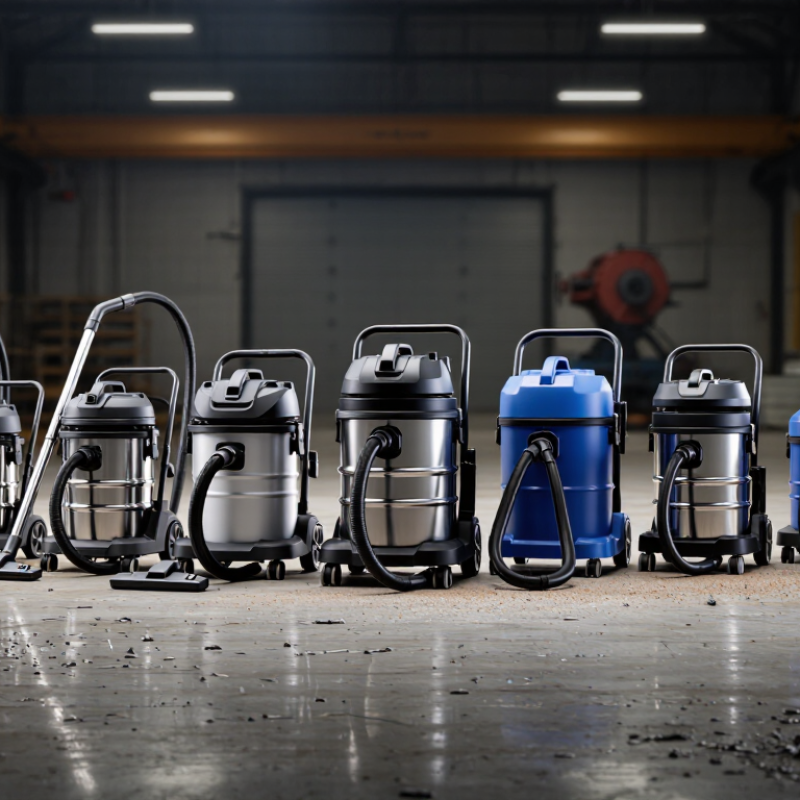
Industrial vacuum cleaners are built for longer shifts, heavier debris, and tougher environments than ordinary shop vacuums. Dry units collect powders and dust; wet/dry models handle liquids, sludge, and mixed spills. Central systems serve fixed production lines, while portable units move between workstations. Different jobs need different machines.
For wood shops, a suitable unit captures sawdust near cutting equipment. Metalworking operations may need wet collection for coolant and swarf. Food-processing sites often prioritize washable contact surfaces and controlled dust capture. Fine-dust work calls for suitable filtration, sealed collection, and filter-cleaning methods. HEPA filtration alone does not describe the performance of an entire vacuum system.
Features worth checking include airflow, static pressure, tank capacity, filter area, and noise level. A stronger motor is not always better. Grand View Research’s 2024 industrial vacuum cleaner market report estimated the global market at about US$1.2 billion in 2023; this is a market estimate, not evidence that one machine suits every task. Match the specifications to the material and duty cycle, then test collection at the point of use. Real floors can be messy. A paper specification will not reveal every leak, clog, or awkward hose bend.
China’s industrial vacuum cleaner manufacturing landscape is built around dense supply networks, practical engineering, and varied production scales. Manufacturers may source motors, filters, hoses, and metalwork from nearby partners, helping shorten development cycles. In established manufacturing regions, buyers can compare wet-and-dry units, dust extractors, and customized systems during one sourcing trip. But capabilities vary.
A factory tour should look beyond polished showrooms. Ask how airflow, sealed housings, and filter performance are checked under load. Request test records for the exact configuration, not a similar model. Confirm spare-part availability, service response times, and whether local voltage and working conditions were considered. These details can reveal gaps that brochures miss. Some buyers focus too heavily on the initial price; it is an easy mistake to make.
Tip: Match the machine to the material, shift length, and floor layout. Check noise levels and filter access in person. A useful specification is only useful when operators can maintain it.
Grand View Research estimated the global industrial vacuum cleaner market at about US$1.6 billion in 2023, with continued growth forecast through 2030. For buyers comparing Chinese manufacturers, market growth matters less than verifiable performance. Ask for test records showing airflow, static pressure, filtration efficiency, and noise levels under stated conditions. A machine that handles fine powder on paper may clog quickly on a real production line. Request a trial using your own material.
Check whether the model’s dust classification and test documentation align with EN 60335-2-69, where relevant to your application. Review motor duty rating, filter-cleaning method, tank capacity, and spare-parts availability. For example, a 30-litre tank may be inconvenient if operators must empty it every hour. Confirm warranty terms and after-sales response times in writing, not only through sales assurances. Brochures can look convincing. Independent test evidence is better.
China’s industrial vacuum cleaner market serves factories, workshops, and production lines with different cleaning demands. These ten manufacturer profiles are best understood through their engineering focus, rather than as a fixed ranking. Some companies build compact units for small workshops, where mobility and simple maintenance matter. Others specialize in heavy-duty machines for long shifts and large floor areas. A few focus on wet-and-dry collection, useful where liquids and dust appear in the same workspace.
Several manufacturers emphasize fine-particle filtration, sealed tanks, or quieter motors. Others develop central vacuum systems that connect multiple workstations through fixed piping. There are also suppliers making machines for metalworking debris, woodworking dust, or food-production cleanup. Their designs can differ in hose diameter, filter access, tank capacity, and available replacement parts. Small details matter. A filter that takes too long to remove can slow routine maintenance.
When comparing manufacturers, buyers should check test documentation, motor specifications, noise data, and service arrangements. Ask how often filters need cleaning under real operating conditions. Request a sample unit or a detailed maintenance demonstration when possible. A polished catalogue is not proof of performance, and published figures may not reflect a dusty, busy factory. Some suppliers provide flexible custom configurations; others offer more standardized models that may be easier to service. The right profile depends on the material collected, daily operating hours, and the support available after installation.
Note: Company names and brands are intentionally omitted. The rows below describe ten common product-specialization profiles found in the industrial vacuum cleaner market; they are not verified company-specific rankings or claims about individual manufacturers.
| Profile | Product specialization | Typical applications | Key selection considerations | Relevant technical reference |
|---|---|---|---|---|
| Profile 1 | Dry industrial dust collection | General workshop cleaning, production-floor dust, and machine-area housekeeping | Check dust type, filter area, airflow, container capacity, and filter-cleaning method. | Filter performance and dust suitability should be specified for the actual material and process. |
| Profile 2 | Wet-and-dry industrial vacuuming | Collection of non-hazardous liquids and dry debris in workshops and maintenance areas | Confirm liquid shut-off protection, tank construction, drainage method, and compatibility with the liquid. | Do not assume a standard wet-and-dry unit is suitable for flammable or otherwise hazardous liquids. |
| Profile 3 | Fine-dust filtration systems | Fine particulate capture in production and facility-cleaning applications | Check the complete filtration configuration, sealing, filter replacement procedure, and test documentation. | Under EN 1822, H13 and H14 filters have specified efficiency requirements measured at the most penetrating particle size. |
| Profile 4 | Dust-classified extractors | Collection of dust where a defined dust-class performance is required by the application | Match the dust class to the material risk assessment; verify the classification applies to the complete machine. | EN 60335-2-69 includes requirements for dust classes such as L, M, and H. |
| Profile 5 | Metal-chip and coolant recovery units | Machine shops and metalworking processes producing chips mixed with cutting fluids | Consider chip separation, liquid capacity, fluid compatibility, drainage, and safe handling of collected waste. | The recovered material and coolant should be assessed for chemical compatibility and disposal requirements. |
| Profile 6 | Oil-mist and airborne-contaminant control | Processes that generate oil mist, such as some machining operations | Determine whether the requirement is source capture, air filtration, liquid recovery, or a combination. | An oil-mist collector and an industrial floor vacuum are different equipment categories; select for the actual control task. |
| Profile 7 | Centralized vacuum systems | Multi-station facilities requiring fixed pipework and multiple cleaning points | System design should account for pipe layout, simultaneous users, pressure loss, filtration, and waste collection. | Capacity must be engineered for the installation; a portable-unit rating alone does not establish system performance. |
| Profile 8 | Compressed-air-powered vacuum units | Applications where an air-driven unit is preferred or electrical power at the point of use is limited | Check available air pressure and flow, air consumption, noise, and the required filtration level. | An air-powered design is not automatically certified or suitable for explosive atmospheres. |
| Profile 9 | Equipment designed for potentially explosive atmospheres | Specified industrial areas where combustible dusts or flammable gases may be present | Verify the hazard assessment, zone, material group, temperature class, and suitability of the complete configuration. | EU ATEX Directive 2014/34/EU covers equipment intended for use in potentially explosive atmospheres; applicability and certification must be verified. |
| Profile 10 | Washable and cleanable equipment configurations | Food, pharmaceutical, and other environments with defined hygiene or cleaning procedures | Assess material compatibility, surface cleanability, seals, disassembly, and the facility's hygiene requirements. | A stainless-steel construction alone does not establish food-contact suitability or compliance with a particular hygiene standard. |
When comparing China’s top industrial vacuum cleaner manufacturers, start with the work each machine must handle. Product ranges may include dry, wet-and-dry, and central vacuum systems. Check dust type, collection capacity, duty cycle, and the size of the hose connection. A unit used beside a CNC machine may need different filtration from one cleaning a warehouse floor. Fit matters.
Technology claims deserve practical checks. Ask for airflow and static-pressure data, not just motor wattage. Filter efficiency, cleaning method, and overload protection affect performance during long shifts. If possible, test a sample with the actual material and hose length. A showroom demonstration can look convincing, yet miss daily operating conditions.
Certifications should match the model and intended use; request current documents and confirm their scope. Service matters just as much. Compare spare-parts availability, response times, commissioning support, and clear operating manuals. Ask how quickly a replacement filter or motor can reach your site. Warranty terms can vary, so read exclusions carefully. A comparison table helps, but it cannot capture every factory’s follow-through. That uncertainty is worth discussing directly with suppliers.