How to Source Stainless Steel Pipe Fittings?

Sourcing stainless steel pipe fittings is not simply a price exercise. It is a materials decision, a compliance decision, and sometimes a safety decision. A fitting may look flawless on a warehouse shelf, yet fail early after exposure to chlorides, heat, vibration, or repeated cleaning.

Grand View Research identifies construction, chemical processing, food production, and energy equipment as important stainless steel demand sectors. Its stainless steel market analysis also links growth with corrosion resistance and longer service life. Fortune Business Insights reports similar expansion across industrial stainless steel applications. These reports offer useful direction, but they do not replace project-specific engineering.

The detail matters.

Corrosion engineer Pierre R. Roberge states in Handbook of Corrosion Engineering, “Corrosion control begins with understanding the environment.” That principle should guide every stainless steel pipe fittings purchase. Ask for the alloy grade, dimensional standard, pressure rating, heat number, mill test certificate, and surface finish. Confirm whether the supplier follows ASME B16.9, ASME B16.11, ASTM A403, or another applicable specification.

A reliable sourcing process also checks weld quality, thread accuracy, wall thickness, and traceability. Request sample photographs, inspection records, and independent verification when the application is critical. A low quotation can hide thinner walls, mixed grades, or incomplete documentation. That risk is easy to underestimate.

Not every project needs the most expensive alloy. However, choosing 304 instead of 316 near saltwater may become an expensive lesson. Supplier experience matters, but evidence matters more. This guide examines how to compare manufacturers, validate technical claims, calculate lifecycle value, and avoid assumptions that appear reasonable but fail in service.
How to Source Stainless Steel Pipe Fittings?

Define Stainless Steel Pipe Fittings and Their Applications

How to Source Stainless Steel Pipe Fittings?

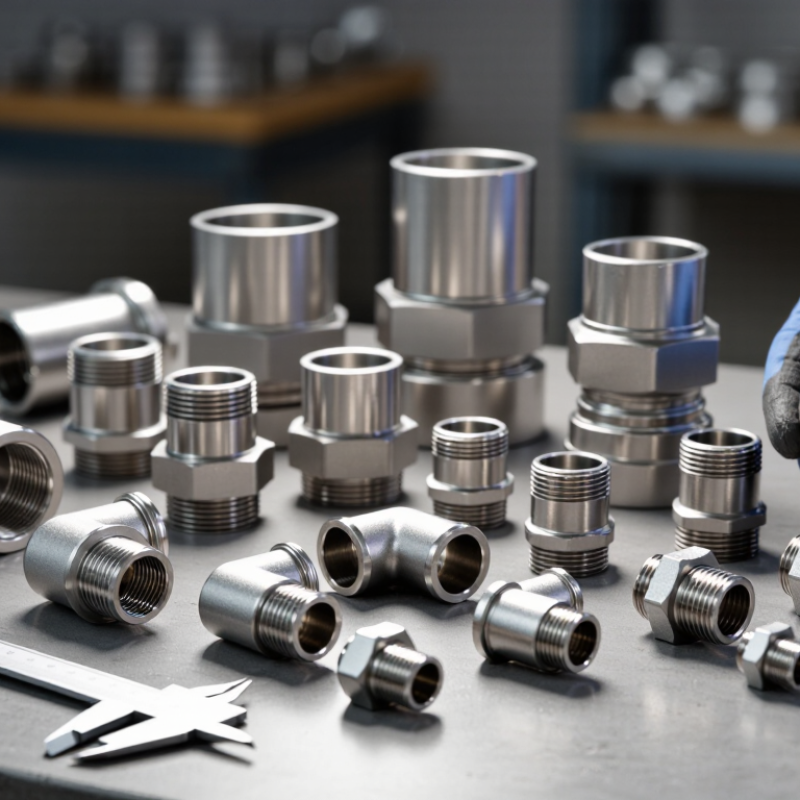
Stainless steel pipe fittings are components that connect, redirect, control, or terminate pipes. Common types include elbows, tees, reducers, couplings, unions, and caps. They are made from corrosion-resistant steel alloys, often selected for strength and hygiene. Their applications range from food processing and drinking-water systems to chemical plants, marine equipment, and high-temperature pipelines. A fitting must match the pipe size, pressure rating, connection method, and service temperature. Small mismatches can cause leaks, vibration, or premature failure. Threaded fittings suit many low-to-medium pressure installations, while welded fittings provide stronger, more permanent joints. Sanitary systems may require smooth internal surfaces and carefully finished welds.

Tips: Confirm dimensions, wall thickness, material grade, and applicable standards before requesting quotations. Ask for inspection records, chemical composition reports, pressure-test evidence, and traceability documents. Check whether the fitting was passivated after fabrication. That detail matters.

A common sourcing mistake is choosing fittings by appearance alone. Bright surfaces can hide poor machining or incorrect material. Compare drawings with actual samples, especially for socket depth and flange alignment. In practical inspections, even a small burr may disturb flow or collect residue. It is easy to overfocus on unit price. Total cost also includes installation time, replacement risk, and compatibility testing. Suppliers should explain production controls clearly and provide consistent documentation. If the application is unusual, involve a qualified engineer before purchase. Assumptions can be expensive.

Identify Required Fitting Types, Sizes, Grades, and Standards

How to Source Stainless Steel Pipe Fittings?

Start with the fitting type, not the catalogue image. Map every connection on the piping drawing. Mark elbows, tees, reducers, couplings, caps, unions, and flanges. A 90-degree elbow may be seamless or welded, with different pressure behavior. Confirm whether the connection uses butt welding, socket welding, threading, or a flange face.

Size details must be precise. Record nominal pipe size, outside diameter, wall thickness, schedule, and end dimensions. Do not treat NPS and actual outside diameter as identical. They are related, but not interchangeable. Check operating pressure, temperature, flow direction, and available installation space. A small mismatch can create costly field rework.

Grade selection depends on the service environment. Grade 304 stainless steel often suits general water and indoor process lines. Grade 316 or 316L offers better resistance in chloride-bearing conditions. Low-carbon grades can support welded systems, but the final choice needs engineering review. Specify applicable standards, such as ASME B16.9 for butt-weld fittings, ASME B16.11 for forged fittings, and ASTM A403 for wrought stainless fittings. Requirements should also cover heat treatment, dimensions, marking, and material test certificates. Request traceability for each lot. If corrosion risk is uncertain, test assumptions rather than guessing. That lesson is easy to overlook. Supplier drawings, inspection records, and independent material verification can expose errors before installation.

How to Source Stainless Steel Pipe Fittings? - Identify Required Fitting Types, Sizes, Grades, and Standards

Fitting Type Typical End Connection Common Size Range Common Stainless Grades Applicable Standards Key Sourcing Specifications Inspection and Documentation
90° and 45° Elbow Butt-weld, socket-weld, or threaded NPS 1/8 to 48, depending on design and standard 304/304L, 316/316L, 321, 347 ASME B16.9 for butt-weld fittings; ASME B16.11 for forged socket-weld and threaded fittings; EN 10253-4 for stainless butt-weld fittings Specify long-radius or short-radius geometry, center-to-end dimensions, wall thickness or schedule, and bend angle. Request dimensional inspection, material test report, heat number traceability, and visual examination.
Equal Tee Butt-weld or socket-weld NPS 1/2 to 48 for many butt-weld applications 304L, 316L, 321, 347 ASME B16.9; EN 10253-4; ASTM A403/A403M material specification Confirm run size, branch size, wall thickness, weld preparation, and whether seamless or welded construction is required. Check branch alignment, bore continuity, wall thickness, surface condition, and chemical composition.
Reducing Tee Butt-weld or socket-weld Main line and branch sizes selected separately 304/304L, 316/316L, 904L for selected services ASME B16.9; EN 10253-4; ASTM A403/A403M List run outside diameter, branch outside diameter, schedule, pressure, temperature, and flow direction. Verify all three connection dimensions and confirm that the reduced branch does not restrict the intended flow rate.
Concentric or Eccentric Reducer Butt-weld NPS 1/2 to 48, subject to product availability 304L, 316L, 321, 347 ASME B16.9; EN 10253-4; ASTM A403/A403M Choose concentric for symmetrical transitions or eccentric for pump suction, drainage, and elevation-sensitive lines. Confirm large-end and small-end dimensions, overall length, orientation, and wall thickness.
Coupling and Half Coupling Threaded or socket-weld NPS 1/8 to 4 under common forged-fitting dimensions 304/304L, 316/316L ASME B16.11; ASTM A182/A182M for forged stainless components; ISO 4144 for selected threaded fittings Specify NPT, BSPT, or another thread form, thread class, socket depth, bore, and pressure class. Inspect thread gauges, thread engagement, socket depth, markings, and forging quality.
Union Threaded or socket-weld Commonly NPS 1/8 to 4 304/304L, 316/316L ASME B16.11; ISO 4144 for applicable threaded designs Specify connection type, nominal size, pressure rating, sealing face, and required disassembly frequency. Check mating alignment, sealing surfaces, thread quality, and leak-test requirements.
Lap-Joint Stub End Butt-weld with loose lap-joint flange NPS 1/2 to 24 under common flange systems 304L, 316L, 321, 347 ASME B16.9 for stub ends; ASME B16.5 for flanges up to NPS 24; ASME B16.47 for larger flanges Specify stub-end type, flange facing, pressure class, bore, lap thickness, and corrosion allowance. Confirm flange compatibility, face dimensions, weld-end geometry, and material traceability.
Blind Flange Bolted flange connection NPS 1/2 to 24 under ASME B16.5; larger sizes under ASME B16.47 304/304L, 316/316L, 321, 347 ASME B16.5 or ASME B16.47; ASTM A182/A182M for forged stainless flanges Specify nominal size, pressure class, facing type, bolt-hole pattern, thickness, and gasket compatibility. Verify flange drilling, face finish, flatness, thickness, heat treatment, and pressure-test requirements.
General sourcing note: Confirm the applicable design code, operating pressure, operating temperature, corrosion conditions, weld procedure, surface finish, and certification requirements before placing an order. Pressure ratings and allowable temperatures must be verified against the selected material, wall thickness, standard, and governing piping code.

Evaluate Manufacturers, Suppliers, Certifications, and Production Quality

How to Source Stainless Steel Pipe Fittings?

Sourcing stainless steel pipe fittings starts with evaluating the manufacturer behind the product. I have learned that a polished website proves little. Ask about melting sources, forming methods, welding controls, and export experience. Request factory photos, process records, and recent inspection reports. If possible, visit the production site. Check whether raw materials are stored separately and clearly labeled. Mixed grades create expensive problems later.

Evaluate the supplier’s communication as carefully as its prices. Request current certificates and verify their issuing bodies independently. Relevant documents may include ISO 9001 registration, material test certificates, and compliance with applicable ASTM or ASME requirements. Do not accept scanned paperwork without traceable heat numbers. Those numbers should connect the fitting to the original steel batch. Ask how complaints, replacements, and delivery delays are handled. Reliable suppliers give precise answers, even when the answer is inconvenient. That matters.

Production quality appears in small physical details. Inspect threads, socket depth, surface finish, and dimensional tolerances. For welded fittings, review weld penetration records and non-destructive testing procedures. Measure sample pieces with calibrated tools, not visual judgment alone. Ask for hydrostatic or pressure-test evidence when the application requires it. I would also compare random samples from different cartons. One perfect sample can hide inconsistent production. This step takes time, but skipping it is a poor saving. I still leave room for doubt when records look complete but factory controls remain unclear.

Compare Prices, Lead Times, Minimum Orders, and Shipping Terms

Sourcing stainless steel pipe fittings starts with a comparable specification, not a low headline price. Ask each supplier to quote the same grade, size, pressure class, connection type, and surface finish. A 316 fitting and a 304 fitting may look identical, yet their corrosion performance and prices differ. Request material certificates, dimensional inspection records, and sample photographs. I prefer a line-by-line quotation. It exposes missing items.

Compare unit prices beside tooling, packaging, testing, and documentation charges. Then check lead time from order confirmation to dispatch, not just production days. A supplier may promise ten days but need another week for approval. Ask whether stock is real and allocated to your order. Minimum orders deserve equal attention. A low price for 1,000 pieces can be less useful than a higher price for 100 pieces. Calculate the landed cost for your actual project.

Shipping terms can change the final number sharply. Confirm carton dimensions, gross weight, loading port, insurance responsibility, and the agreed Incoterm. Also ask who handles export documents and whether partial shipments are allowed. I have seen schedules fail because one small fitting delayed a full container. That risk is easy to overlook. Build a comparison sheet with price, lead time, MOQ, payment terms, and shipping cost. My own spreadsheets have been wrong when freight surcharges changed after quotation. That is an uncomfortable lesson, but a useful one.

Inspect Samples and Finalize the Purchase Agreement

When sourcing stainless steel pipe fittings, sample inspection should happen before price negotiations end. A sample can reveal more than a polished catalog. Check the outside diameter, wall thickness, thread condition, and overall length with calibrated tools. Small details matter. Inspect welds for cracks, pinholes, uneven beads, or excessive grinding. The surface should be clean and consistent, without deep scratches or discoloration. Confirm the material grade, heat number, and marking method against the requested specification.

Do not trust appearance alone. Request a material certificate and dimensional inspection report for the sample. For demanding service, consider chemical verification or pressure testing through a qualified inspection provider. The sample should represent normal production, not a specially prepared piece. Photograph each measurement and record the equipment used. It is easy to overvalue a bright surface; even experienced buyers can make that mistake. Recheck critical dimensions after handling and cleaning.

The purchase agreement should describe every accepted detail clearly. Include material grade, dimensions, tolerances, surface requirements, quantity, packaging, delivery dates, and required documents. State how production samples will be compared with delivered fittings. Define inspection rights, nonconformance handling, replacement duties, and payment milestones. Add traceability requirements for batches and heat numbers. Avoid vague phrases such as “premium quality.” Write measurable standards instead. Leave room for approved changes, but require written confirmation before production continues. Both parties should review the final drawings and inspection criteria before signing.