
Email Id: sale@adctooling.com
Metal tool storage is a practical buying category, but comparing manufacturers takes more than judging a polished product photo. Grand View Research estimated the global hand tools market at USD 24.6 billion in 2023 and forecast continued growth through 2030. That figure covers hand tools broadly, not toolboxes alone. Still, it signals the scale of the professional and industrial markets that storage suppliers serve.
For global buyers, the details matter. A loaded steel drawer should slide smoothly; a latch should stay shut during transport. Sheet thickness, weld quality, corrosion-resistant finishes, and replacement-part availability can separate a dependable unit from a frustrating one. These specifications deserve checking against product sheets and, where possible, samples. A glossy coating is not proof of long service life.
This guide introduces ten Metal Tools Box manufacturers for buyers comparing export capability, product range, customization, and purchasing support. It is not a universal ranking: the best supplier depends on the application, budget, order volume, and destination market. Ask about packaging, lead times, warranty terms, and documented quality checks before placing an order. Small details matter.
One limitation is worth noting: public market reports rarely isolate metal toolboxes from the wider storage or hand-tool categories. Buyers should therefore treat broad market figures as context, not as proof that any one manufacturer leads the field. A careful comparison may take longer. It usually pays off.
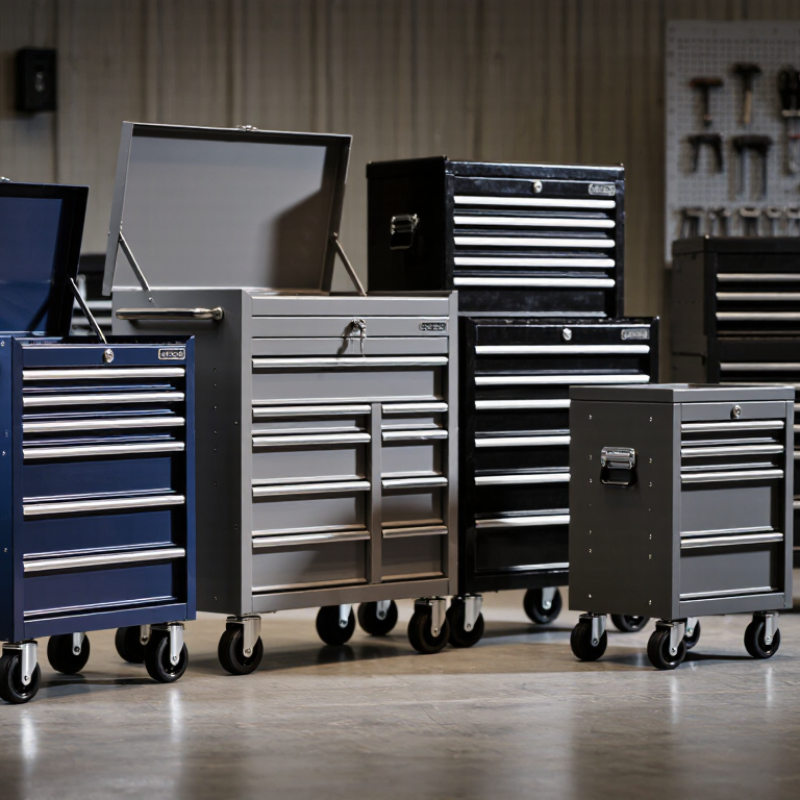
A metal tool box is a rigid storage case with a metal body, hinged or sliding access, and compartments for tools. Steel is common because it resists impact and supports heavy loads; aluminum is lighter and easier to carry. Construction details matter. Check the gauge, seams, lid alignment, handle attachment, and finish. Thin panels may dent when a box rides in a work vehicle. A good latch should close cleanly, even when the box is full.
The main types serve different work habits. Portable hand boxes suit small repair kits and often include a lift-out tray. Cantilever boxes open in stepped layers, keeping sockets and fasteners visible. Chest-style boxes offer deeper storage for larger tools, while drawer cabinets organize equipment in workshops or service vehicles. World Steel Association data puts global crude steel production at 1,892.2 million tonnes in 2023. This signals a broad material supply, not a guarantee of toolbox quality. That distinction is easy to miss.
Tips: Match capacity to the heaviest tools, not just the box’s outside dimensions. Test the handle with a realistic load. Look for sharp interior edges, weak hinges, and water-trapping corners. A small flaw can matter. One trade-off remains: steel is durable, but a large loaded box can be awkward to move.
Top 10 Metal Tool Box Manufacturers for Global Buyers
How to Assess Metal Tool Box Manufacturers for Global Sourcing
For global sourcing, assess a manufacturer’s process, not just its catalogue. Ask about steel grade, sheet thickness, weld consistency, hinge construction, and drawer load ratings. Request drawings with key dimensions and tolerance ranges. Numbers matter. A clear answer should explain how measurements are checked during production, not only at final inspection. Also ask how finishes are tested for scratches, moisture exposure, and corrosion. The exact test method should match your product’s intended use.
Review quality records, sample parts, and production capacity before discussing large orders. A sample can reveal sharp edges, uneven powder coating, or a lid that does not sit flush. Still, one good sample cannot guarantee consistent production. Ask how the factory tracks batches and handles defects. Confirm lead times, packaging details, and export documents in writing. If communication is vague during early discussions, resolving a shipment issue may be harder later. No checklist catches everything.
Tips: Send a simple inspection checklist with your inquiry. Compare quotes using the same specifications, not just unit price. Request photos of packed cartons and ask how damage claims are documented. A third-party inspection can help, but it cannot replace clear requirements agreed with the supplier.
A practical, weighted checklist for evaluating suppliers. These are assessment criteria—not a ranking of named manufacturers or claims about any specific supplier.
| Assessment Dimension | Weight | Evidence to Request | Practical Evaluation Benchmark | Warning Signs |
|---|---|---|---|---|
| Product and engineering capability | 15% | Product drawings, material specifications, sample units, and details of available sizes, drawer layouts, locks, handles, and finishes. | Confirm that the supplier can manufacture to an approved drawing and document any proposed substitutions before production. | Unapproved material or design changes; inability to provide dimensioned drawings or a representative sample. |
| Quality management and inspection | 12% | Quality procedures, inspection records, nonconformance reports, corrective-action records, and any applicable quality-system certificates. | Agree written incoming, in-process, and final inspection requirements, with acceptance criteria tied to the product specification. | Inspection is described only in general terms, or failed units and corrective actions are not recorded. |
| Metal and component traceability | 12% | Material grades and thicknesses, supplier declarations or mill documents where applicable, and records linking production batches to materials. | Require the exact material grade and thickness to be stated in the purchase specification; verify documents against a sample batch. | Material is specified only as “steel” without an agreed grade or thickness, or documentation cannot be linked to production. |
| Fabrication and assembly controls | 10% | Process flow, equipment list, examples of weld and forming checks, assembly checks, and records for critical dimensions. | Check sample units for fit, alignment, smooth drawer movement, secure joints, and consistency with approved drawings. | Critical operations are not inspected, or production methods cannot consistently meet the agreed dimensions and function. |
| Surface finish and corrosion protection | 10% | Finish options, pretreatment details, coating specifications, test methods, and sample panels or finished-product samples. | Specify the coating and appearance requirements in writing; agree any adhesion, thickness, or corrosion tests based on the intended use. | Finish acceptance relies on vague terms such as “standard quality,” with no agreed visual limits or test requirements. |
| Production capacity and lead-time reliability | 10% | Capacity by product type, production schedule, stated lead time, and delivery-performance records for comparable orders. | Compare the supplier’s confirmed schedule with your required ship date; use a defined on-time delivery target, such as 95%, if suitable for the program. | Capacity figures are unsupported, lead times exclude key production stages, or delays are not communicated promptly. |
| Packaging and export readiness | 8% | Packaging specifications, carton dimensions and weight, drop or handling test results where relevant, and loading or palletization plans. | Approve packaging against the product’s weight, finish, shipment method, and destination handling conditions; confirm shipping marks in advance. | Packaging has not been tested or reviewed for transit damage, or carton and loading details are unavailable. |
| Compliance and product documentation | 8% | Product specifications, test reports, declarations, and market-specific documentation applicable to the product and destination. | Identify destination-market requirements before ordering and verify that documents match the exact product, materials, and configuration. | Documents are generic, expired, issued for a different product, or presented as universally valid without checking destination rules. |
| Commercial terms and total landed cost | 8% | Itemized quotation, tooling or setup charges, minimum order quantity, payment terms, quotation validity, and proposed Incoterm and named place. | Compare like-for-like specifications and calculate landed cost, including freight, insurance, duties, inspection, and packaging where applicable. | Unclear inclusions, unexpected charges, or an Incoterm stated without the required named place and edition. |
| Communication and supply-chain risk | 7% | Named points of contact, escalation process, subcontracting disclosure, business references where available, and contingency plans for disruption. | Set response and approval timelines, disclose critical subcontractors, and agree how changes or production risks will be reported. | Unreported subcontracting, inconsistent specifications across communications, or no clear escalation route. |
Scoring guide: Score each dimension from 1 to 5, multiply the score by its weight, and add the weighted results. Treat numeric benchmarks as buyer-defined targets, not universal industry rules; confirm requirements against the product, destination market, order volume, and contract.
These ten profiles describe different metal tool box manufacturing strengths, rather than ranking named companies. A heavy-duty fabricator builds reinforced boxes with folded steel corners and thick hinges for demanding workshop use. A modular-storage producer focuses on stackable units, interchangeable drawers, and cabinets that fit changing shop layouts. An automotive-service specialist designs rolling chests with smooth drawer slides and compartments for frequently used hand tools.
A portable-equipment maker favors lighter steel, secure latches, and handles that remain comfortable during short carries. An industrial supplier may offer corrosion-resistant finishes for damp or dusty work areas. A custom-order manufacturer can adjust dimensions, drawer layouts, or foam inserts, though special designs may require longer lead times. An export-focused producer typically pays close attention to protective packaging; dented corners still happen when pallets are handled poorly.
A volume manufacturer aims for consistent dimensions and repeatable production, often serving buyers who need multiple units. A precision-storage maker emphasizes close-fitting drawers and organized small-parts trays. A value-focused producer keeps features simple to control cost, but buyers should inspect finish quality and load ratings. Finally, a mixed-product manufacturer may combine tool boxes with workbenches and cabinets, which can simplify planning for a complete workspace. These categories overlap. Comparing steel thickness, weld quality, drawer movement, and replacement-part availability gives buyers more useful evidence than a product photo alone.
Material choice affects toolbox weight. These approximate room-temperature densities are reference values, not manufacturer-specific product measurements; actual values vary by alloy and construction.
For global buyers comparing metal tool box manufacturers, production region can shape lead time, cost, and customization options. East and Southeast Asian factories often offer broad fabrication capacity, while suppliers in Europe and North America may be closer to specialized engineering or regional distribution networks. These are general patterns, not guarantees. A factory’s actual equipment, workforce, and subcontractors matter more than its location.
Check how each manufacturer verifies dimensions, weld quality, drawer movement, and coating durability. Ask for test records tied to the model you plan to order, not only a general quality certificate. ISO 9001 describes a quality management system; it does not certify every toolbox design. Export readiness also matters. Confirm carton or pallet specifications, shipment markings, lead times, and whether commercial and packing documents match the order. Small mismatches can delay receiving.
Tips: Request a sample with the same steel thickness, finish, and drawer configuration as production units. Check the lid fit and handle under load. Clarify corrosion-test methods and acceptance limits in writing. If answers are vague, pause. One detail is easy to miss: a strong sample does not prove consistent mass production, so agree on inspection points before the first shipment.
Global buyers should compare manufacturers on repeatable production, not catalogue photos. The World Bank’s 2023 Logistics Performance Index assesses 139 economies across six areas, including customs, infrastructure, shipment tracking, and delivery timeliness. These measures matter when a metal toolbox must arrive intact and on schedule. Ask each supplier for written specifications covering steel thickness, drawer load capacity, weld inspection, coating, and packaging. Small details matter. A stated “heavy-duty” rating means little without a test method or load figure.
Request a pre-production sample, then inspect sharp edges, lid alignment, latch movement, and coating around welds. Compare the sample with the production inspection plan; one good unit cannot prove consistent output. Ask for recent inspection records, defect-handling procedures, realistic lead times, and clear rules for replacements. Also check how the supplier protects toolboxes during shipment: corner guards and internal bracing can prevent dents that photos never show. The LPI is a country-level benchmark, not a factory score, so it cannot verify a manufacturer’s performance. That limitation is easy to overlook. Use it to frame logistics questions, then verify factory-specific claims with documents and a physical sample. I would keep a little uncertainty in the comparison: production quality can vary between batches, even when the first sample looks excellent.