Email Id: sale@adctooling.com
Choosing ptfe lined pipe fittings requires more than matching pipe diameters. Chemical compatibility, operating temperature, pressure, and installation conditions all influence long-term performance. A fitting may look suitable on paper but fail when exposed to aggressive chemicals, repeated thermal cycling, or unexpected vacuum conditions.
Field experience shows that small details matter. Liner thickness, flange alignment, sealing surfaces, and grounding requirements deserve careful inspection. Fit is everything. Reliable suppliers should provide material certificates, dimensional drawings, pressure ratings, and clear manufacturing information. Independent testing or documented quality procedures can add confidence, especially in critical process systems.
This guide presents ten practical tips for evaluating ptfe lined pipe fittings before purchase and installation. It considers the chemical service, connection type, temperature range, pressure limits, and maintenance demands. It also explains why installation quality can matter as much as product selection. A damaged PTFE liner may remain hidden behind a flange, yet create leakage risks later. Careful inspection helps prevent that problem.
No selection method is flawless. Real systems often involve incomplete data, changing process conditions, or rushed decisions. That is where professional judgment becomes essential. Confirm assumptions with process engineers, qualified manufacturers, and current technical documentation. When information conflicts, pause and verify it. A small mistake at the specification stage can become an expensive shutdown. These tips are designed to support safer decisions, while leaving room for review, testing, and practical experience.
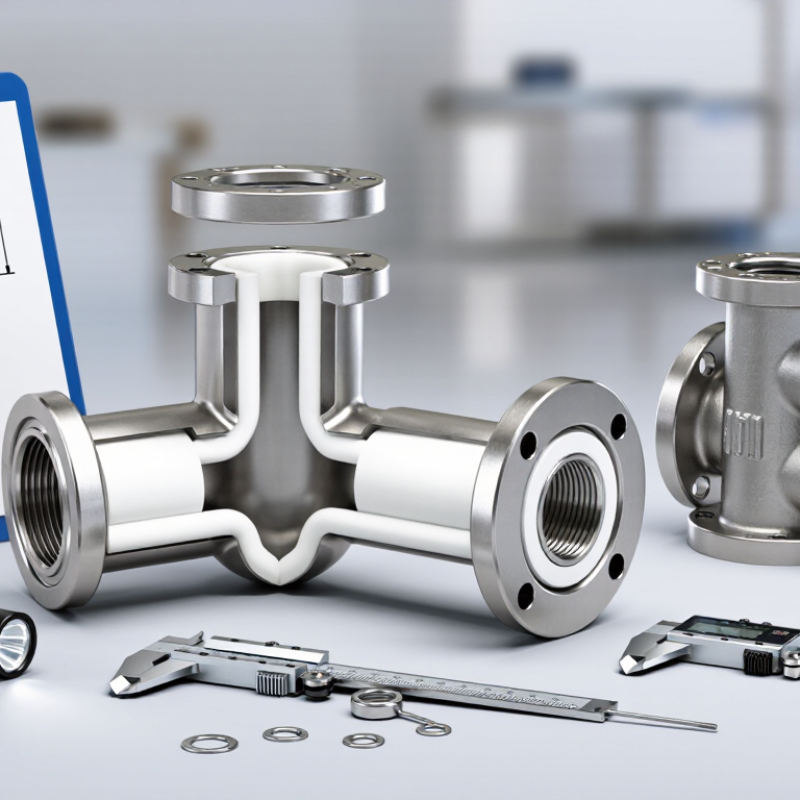
PTFE lined pipe fittings combine a strong outer shell with an inner layer of polytetrafluoroethylene. The shell provides mechanical support, while PTFE resists many aggressive chemicals. It also offers a smooth, non-stick surface that reduces buildup and friction. These fittings commonly include elbows, tees, reducers, and flanges.
Their main applications include chemical processing, pharmaceutical production, semiconductor manufacturing, wastewater treatment, and specialty food systems. Engineers use them for acids, alkalis, solvents, and corrosive slurries. However, PTFE is not suitable for every service. Temperature, pressure, chemical concentration, and permeation must be checked together. Not every process fits.
During selection, experienced maintenance teams inspect the lining for pinholes, cracks, and poor flange seating. They also confirm the fitting’s pressure rating and operating temperature. A small mismatch can cause leakage or premature failure. Vacuum service deserves special attention because the lining may deform under unsuitable conditions. Small details matter. Clean installation is important, too, since metal tools can damage the PTFE surface.
A practical choice depends on the full piping system, not only the fluid name. Chemical compatibility charts provide useful guidance, but real operating conditions may differ. Flow velocity, thermal cycling, and frequent cleaning can change performance. This is where a cautious review helps. Assuming “PTFE means unlimited resistance” is a common mistake, and it can become an expensive one.

Choosing PTFE lined pipe fittings starts with the process fluid, not the fitting size. List every chemical, including cleaning agents, additives, and trace contaminants. A fitting may resist the main chemical but fail against a minor solvent. Check concentration, exposure time, and operating temperature together. Compatibility charts are useful, but they are not final approval.
Temperature changes the lining’s behavior. Record normal, minimum, and maximum temperatures, including short cleaning cycles. PTFE generally handles severe chemical service, yet repeated thermal cycling can stress flared areas and connections. Ask for data on permeation, dimensional stability, and vacuum service. Small details matter. A hot pipe beside a cold wall can create uneven expansion. I have seen inspection teams miss this because the process temperature looked acceptable on paper.
Pressure review must include start-up, shutdown, pump pulsation, and possible vacuum conditions. Compare the fitting’s rated pressure with the actual pressure at the highest temperature. Do not rely only on room-temperature values. Check flange alignment, bolt loading, and support spacing before installation. Excessive tightening may damage the lining or distort the sealing surface. That mistake is easy to make. A written specification should state fluid chemistry, concentration, temperature range, pressure profile, lining thickness, and inspection requirements. It should also identify assumptions that still need verification. Even experienced engineers occasionally overlook a brief pressure spike. Fresh review prevents expensive rework.
10 Tips for Choosing PTFE Lined Pipe Fittings
Select Compatible Lining, Base Metal, and Fitting Configuration
PTFE lining should match the chemicals, temperature, pressure, and cleaning cycle. Check concentration changes, not only the normal operating fluid. Ask for permeation data when solvents or gases are involved. Verify the lining’s temperature rating under pressure. A room-temperature rating can mislead. Inspect lining thickness and the flare near each sealing face. Small wrinkles can become leak paths.
Select the base metal for the outside environment, not only internal chemistry. Carbon steel may suit dry service, while moisture can require stronger corrosion resistance. Confirm flange dimensions, pressure class, and bolt-hole alignment. Choose elbows, tees, reducers, or sight sections around actual flow needs. Avoid sharp transitions where solids could collect. Consider vacuum conditions carefully. Some fittings need reinforcement or support. A smooth bore can improve cleaning and reduce pressure loss.
Review gasket compatibility with PTFE and the mating flange. Control bolt torque with a calibrated tool. Over-tightening may damage the flare. Request material certificates and inspection records for critical lines. Have an experienced engineer check thermal expansion and dead-leg risks. I have seen projects focus on lining chemistry and overlook the base metal. That mistake is expensive. Recheck dimensions after installation, not only before shipment. Site conditions often differ from drawings. Check carefully.
| Tip | Selection Dimension | What to Check | Practical Selection Guidance | Important Technical Note |
|---|---|---|---|---|
| 1 | Confirm the chemical compatibility | Process fluid, concentration, temperature, pressure, and exposure time | Use PTFE when broad chemical resistance is required, including service with many acids, alkalis, solvents, and oxidizing chemicals. | Compatibility depends on operating temperature and chemical concentration; do not rely on the chemical name alone. |
| 2 | Choose the appropriate PTFE lining type | Virgin PTFE, modified PTFE, conductive or antistatic lining, and manufacturing method | Select virgin or modified PTFE for general corrosion resistance. Consider an electrically conductive or antistatic grade where static charge can create a process risk. | Filled or conductive PTFE can have different chemical, electrical, and mechanical properties from unfilled PTFE. |
| 3 | Match the base metal to the environment | External atmosphere, structural loads, temperature, moisture, and corrosion exposure | Carbon steel is commonly used for strength and economy in controlled environments. Stainless steel or other corrosion-resistant alloys may be preferable in wet, hygienic, or corrosive surroundings. | The PTFE protects the wetted surface, but the external metal remains exposed to the surrounding atmosphere and supports the assembly mechanically. |
| 4 | Verify the temperature and pressure limits | Maximum and minimum operating temperature, pressure, vacuum, thermal cycling, and flange loads | PTFE is often used across a wide temperature range, but the allowable pressure generally decreases as temperature increases. Check the complete fitting rating at the actual design conditions. | The fitting, flange, liner, gasket, and bolts must be evaluated as one pressure-containing system. |
| 5 | Select the correct fitting configuration | Elbow, tee, reducer, cross, sight glass, expansion joint, or lined spool requirement | Use elbows to change direction, tees for branches, reducers for diameter transitions, and lined spools for straight runs. Choose the configuration that minimizes unnecessary joints and dead legs. | A smoother and simpler flow path can reduce pressure loss, accumulation, and cleaning difficulty. |
| 6 | Match the nominal size and end connection | Pipe nominal size, inside diameter, flange standard, facing, drilling, and mating components | Confirm that the lined fitting has the same nominal size and compatible flange dimensions as the connected pipe, valve, pump, or vessel nozzle. | A dimensional mismatch can cause leakage, restricted flow, bolt-hole misalignment, or excessive stress on the liner. |
| 7 | Check liner thickness and coverage | Lining thickness, flange-face coverage, weld-end treatment, pinholes, and exposed metal areas | Specify continuous PTFE coverage over all wetted surfaces, including the fitting body and flange sealing area. Select thickness according to corrosion allowance, pressure, and service severity. | The liner should not be damaged, excessively stretched, folded, or mechanically trapped during installation. |
| 8 | Consider vacuum and permeation resistance | Full vacuum, pressure cycling, gas service, permeating chemicals, and temperature changes | For vacuum or permeating service, verify liner support, vacuum resistance, venting provisions, and the suitability of the PTFE grade for the chemical involved. | PTFE offers strong chemical resistance, but some chemicals can permeate polymers; pressure cycling may also affect liner performance. |
| 9 | Specify inspection and testing requirements | Visual inspection, dimensional checks, electrical continuity, spark testing, hydrostatic testing, and documentation | Require inspection of the liner, flange faces, bore, and transitions. Where applicable, use a suitable high-voltage spark test to detect pinholes and perform pressure testing according to the project specification. | Testing voltage and pressure-test procedures must be selected to avoid damaging the PTFE lining or connected equipment. |
| 10 | Plan installation, maintenance, and replacement | Bolt tightening, alignment, support, thermal movement, cleaning method, and spare-part requirements | Align piping without forcing the fittings, use controlled bolt tightening, provide adequate support, and prevent tools or sharp objects from contacting the liner. | Avoid over-tightening, misalignment, abrasive cleaning, and unsupported piping loads because these can damage the liner or flange seal. |
10 Tips for Choosing PTFE Lined Pipe Fittings
Tip 1: Measure the pipe outside diameter, wall thickness, and lining thickness. A small error can prevent proper seating. Tip 2: Confirm the nominal size and pressure rating on every drawing. Do not rely on appearance. Tip 3: Check flange dimensions, bolt-hole spacing, and facing details before ordering. I have seen a perfect fitting fail because one hole pattern differed.
Tip 4: Match the fitting to the required standard, such as ASME, DIN, or another approved specification. Tip 5: Verify whether dimensions follow the pipe standard or the fitting standard. They are not always identical. Tip 6: Review temperature, pressure, and chemical-service limits together. PTFE may resist the chemical, while the metal backing needs separate evaluation. Tip 7: Ask for material certificates and inspection records when traceability matters. Reliable documentation supports safer decisions.
Tip 8: Confirm the connection type, including flanged, threaded, socket-weld, or butt-weld ends. Tip 9: Check whether the liner extends across the sealing face. It matters. Tip 10: Compare bolt length, gasket style, and available installation space. A compact layout can create unexpected tool access problems.
During installation, protect the liner from sharp tools and excessive bolt torque. Tighten bolts in a cross pattern, then recheck alignment. My own review process is not flawless; drawings can contain outdated revisions. Keep the latest approved dimensions beside the fitting, and question anything that seems unusually convenient.
The chart shows standard nominal pipe sizes and reference outside diameters in millimetres. These dimensions are commonly used when checking PTFE-lined pipe fittings against ASME B36.10M and ASME B36.19M pipe references. Confirm the applicable standard, lining thickness, flange facing, pressure class, temperature rating, and connection type before ordering.
Reference: Outside-diameter values are based on standard NPS pipe dimensions. Schedule selection changes wall thickness and internal diameter, while the nominal outside diameter remains the standard reference for each NPS size.
10 Tips for Choosing PTFE Lined Pipe Fittings
Verify the lining thickness, surface finish, and material certificate before ordering. Tip 1: Match the PTFE grade to the chemical service. Tip 2: Confirm pressure and temperature limits. Tip 3: Inspect flanges for even faces and clean bolt holes. Small defects matter. In field inspections, uneven flange faces often cause leaks after thermal cycling. Tip 4: Check dimensional standards against the existing pipe system. Tip 5: Review the fitting’s vacuum rating, especially for suction lines.
Installation needs deserve equal attention. Tip 6: Measure the actual pipe alignment, not only the drawings. Tip 7: Use compatible gaskets and controlled bolt torque. Tip 8: Protect the PTFE surface from sharp tools and dropped hardware. I once accepted a fitting after checking its dimensions but missed a damaged sealing edge. That shortcut was a mistake. The connection required rework and delayed testing. Tip 9: Allow expansion where long, heated sections can move. Tip 10: Keep installation records, including torque values and inspection photos.
Long-term maintenance begins before startup. Flush the line with a suitable medium, then inspect joints during the first operating cycle. Watch for seepage, unusual movement, discoloration, or pressure loss. PTFE can resist aggressive chemicals, but it is not immune to mechanical damage or excessive heat. Schedule inspections according to service severity, and replace questionable fittings rather than forcing them back into use. One overlooked detail can become a costly shutdown.