
Email Id: sale@adctooling.com
Aluminum Tube Evaporator technology sits at the intersection of heat transfer, materials engineering, and reliable production. These components move heat through refrigeration and air-conditioning systems, where tube dimensions, fin contact, and refrigerant distribution affect performance. Small details matter. A poorly matched design may raise pressure drop, complicate assembly, or shorten service life.
Demand for cooling makes supplier selection increasingly important. The International Energy Agency’s The Future of Cooling report (2018) projects that global electricity demand for space cooling could rise from about 2,020 terawatt-hours in 2016 to 6,200 terawatt-hours by 2050. That forecast is not a direct measure of evaporator sales, but it signals the scale of the equipment market these manufacturers serve. Buyers still need to assess each supplier against the application, rather than assume market growth guarantees product quality.
This guide introduces ten China-based manufacturers and considers practical factors such as product range, customization, production capability, quality documentation, and export experience. Public company information can be incomplete or difficult to compare. That is a limitation worth stating. A company profile is not a factory audit, and published capacity figures may not be independently verified. Before choosing a supplier, request current specifications, material details, test records, and samples suited to the intended system. The strongest shortlist is the one supported by evidence—not just a polished catalogue.
An aluminum tube evaporator transfers heat from passing air into refrigerant flowing through its tubes. Its core typically combines aluminum tubes, fins, and headers that distribute refrigerant among multiple circuits. The fins add contact area. Without them, a compact coil would collect much less heat from the air.
At the inlet, an expansion device lowers the refrigerant’s pressure. The colder refrigerant absorbs heat inside the tubes and boils as it moves through the coil. The outlet carries vapor toward the compressor. Circuit layout matters: uneven flow can leave some tube sections underused while others run warmer. The pattern is rarely perfectly even.
Air moves across the fins by fan or natural convection, warming as the refrigerant takes up heat. Dust and frost can restrict airflow, so spacing and cleaning access are practical design concerns. Tube joints and headers also need careful inspection; a leak can reduce performance and complicate servicing.
In manufacturing, pressure and leak checks help verify the assembled coil, but test results depend on the specified method and conditions. A tidy diagram makes operation look uniform. Real coils are less forgiving.
Evaluate aluminum tube evaporator manufacturers against your actual operating conditions, not catalog claims. Specify refrigerant, capacity, airflow, temperature range, and available installation space. Ask for dimensional drawings, alloy and wall-thickness specifications, and documented leak and pressure-test procedures. A sample should be checked for fin spacing, tube joints, and consistent airflow. Small variations matter.
Request thermal-performance data with clearly stated test conditions, plus repeatability results from production units. The International Energy Agency’s The Future of Cooling report estimates that global energy demand for space cooling could more than triple by 2050. That projection makes efficiency testing and reliable production controls important selection criteria. It is not, by itself, proof that one evaporator design will perform well in your system. Ask how the manufacturer verifies corrosion resistance, manages batch traceability, and investigates field failures. A polished brochure is not proof. Even a strong test report deserves scrutiny if its conditions differ from yours.
Tips: Request a sample, a recent test report, and a factory quality-control record. Compare them against your own operating requirements. If measurements or test conditions are unclear, ask for clarification before approval.
China’s aluminum tube evaporator market serves refrigeration, automotive, and HVAC applications. The ten manufacturer profiles below highlight practical capabilities rather than make unsupported performance rankings. One profile centers on high-volume production. Another focuses on custom tube layouts. A third emphasizes compact cores for tight installation spaces. A fourth offers varied fin spacing for different airflow needs.
Other profiles include manufacturers specializing in controlled-atmosphere brazing, corrosion-resistant surface treatments, prototype development, automated leak testing, and made-to-order dimensions. The tenth profile combines evaporator production with design support for equipment makers. These capabilities can overlap, and a polished catalogue does not prove consistent output. Buyers should check sample workmanship, dimensional reports, and production capacity directly. Small details matter: uneven fin spacing or a weak joint can affect heat transfer and reliability.
Tips: Request drawings, material specifications, pressure-test records, and a production sample. Confirm that the quoted design matches your operating temperature and available installation space. Some supplier information may be incomplete, so verify it before comparing offers.
China Top 10 Aluminum Tube Evaporator Manufacturers
Manufacturing Capabilities and Industry Applications
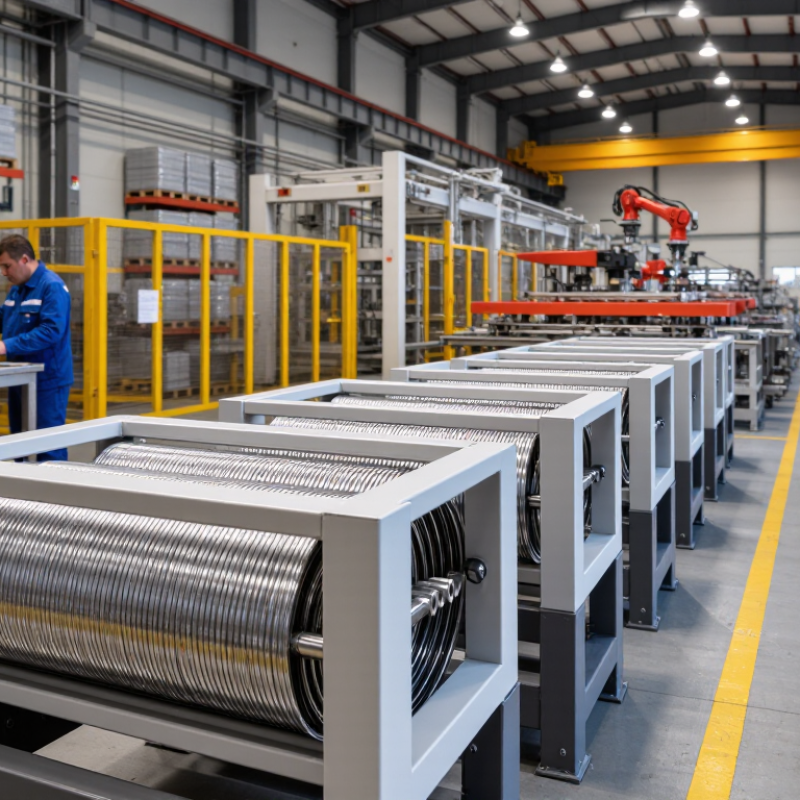
Aluminum tube evaporators rely on controlled forming, fin assembly, and sound brazing. Capable factories manage tube diameter, wall thickness, fin pitch, and joint quality across repeat production runs. They also use helium or pressure-decay leak checks, followed by thermal and corrosion testing. Small defects matter.
Design choices depend on the duty cycle. Compact fin-and-tube cores suit vehicle air conditioning and commercial chillers; microchannel designs can reduce refrigerant charge and package weight, but require careful flow balancing. A bright sample is not proof of stable output. Buyers should review test methods, tolerances, and traceability—not only annual capacity.
Demand is expanding. The IEA’s The Future of Cooling (2018) projected global air-conditioner stock would rise from 1.6 billion units in 2016 to 5.6 billion by 2050. Its The Future of Heat Pumps (2022) reported that global heat-pump sales grew 11% in 2022. These trends raise demand for efficient evaporators in HVAC, heat pumps, refrigerated display cases, and cold-chain equipment. Performance still depends on the whole system: airflow, refrigerant distribution, and installation can outweigh a polished component specification. Manufacturers need flexible tooling, reliable inspection, and designs validated under real operating conditions. Yet field data is sometimes thin. That deserves attention.
Selecting a Chinese aluminum tube evaporator supplier requires more than comparing quotations. Check alloy grade, tube diameter, wall-thickness tolerance, fin spacing, and joining method against your operating conditions. Ask for inspection records covering pressure, leakage, and corrosion resistance. Request samples and verify performance using your own refrigerant, airflow, and temperature range. Small differences matter. A slightly uneven tube bend can restrict airflow or complicate assembly.
Market demand makes production capability worth checking. The United Nations Environment Programme’s Global Cooling Watch 2023 report projects that global cooling capacity could more than triple by 2050 under current trends, while cooling-related electricity demand could more than double. Ask suppliers how they manage order peaks, material traceability, and changes between production batches. Review recent test reports, quality-control procedures, and realistic lead times. Factory visits help, but a visit alone does not prove consistent output.
Tips: Put measurable requirements in the request for quotation, including dimensions, allowable tolerances, test pressure, and packaging. Compare the same specifications across suppliers. Check whether sample results match later production lots. One detail is easy to miss: unclear acceptance criteria can turn a low unit price into costly rework. It is worth admitting that no checklist catches every production issue; keep a first-order inspection plan.
Supplier evaluation checklist. The items below are selection criteria, not rankings or claims about specific manufacturers. Technical requirements should be confirmed for the intended application.
| No. | Evaluation Dimension | What to Check | Useful Evidence or Buyer Action |
|---|---|---|---|
| 1 | Product and process capability | Confirm the supplier can produce the required tube geometry, fin arrangement, headers, joints, and connection details for the specified evaporator design. | Request drawings, process-flow details, and samples representative of the proposed production process. |
| 2 | Material and alloy control | Check alloy and temper, tube and fin material specifications, material compatibility, and any restrictions required for the refrigerant and operating environment. | Review material certificates and incoming inspection records; specify the required alloy, temper, and applicable material standard in the purchase documents. |
| 3 | Dimensional consistency | Assess control of tube diameter and wall thickness, coil or core dimensions, fin spacing, connection locations, and drawing tolerances. | Ask for a dimensional inspection report based on the approved drawing and confirm measurement methods for critical features. |
| 4 | Thermal performance validation | Compare capacity, airflow or refrigerant-side pressure drop, and other performance data only when test conditions match the intended operating conditions. | Request test reports stating refrigerant, inlet conditions, airflow, test method, and measurement uncertainty; agree acceptance limits before production. |
| 5 | Pressure and leak testing | Verify the design pressure and the inspection or test requirements appropriate to the product, refrigerant, and applicable regulations. | Agree the test method, pressure, duration, sampling plan, and leak acceptance criteria in writing; request calibrated equipment and recorded results. |
| 6 | Joining and workmanship | Inspect brazed, welded, or mechanically joined areas for consistency, cleanliness, alignment, and signs of damage or blockage. | Review process controls and inspection criteria; evaluate pre-production samples and define defect limits with visual references where practical. |
| 7 | Quality management and traceability | Check whether documented quality controls cover incoming materials, production inspections, nonconforming product, corrective actions, and lot identification. | Verify current certification and its scope where relevant, and ask for a sample inspection record and a demonstration of batch traceability. |
| 8 | Corrosion and service environment | Consider humidity, salt exposure, condensate drainage, dissimilar-metal contact, and any required coating or surface treatment. | Define the intended environment and required validation. Treat accelerated corrosion results as comparative evidence, not a direct guarantee of service life. |
| 9 | Compliance and documentation | Identify destination-market requirements for materials, restricted substances, product safety, labeling, and technical documentation. | Request declarations and supporting documents applicable to the specific product and market; verify that documents cover the supplied configuration. |
| 10 | Capacity, delivery, and total cost | Evaluate production capacity, lead-time assumptions, minimum order quantities, packaging, shipping terms, change control, and after-sales response. | Request a written quotation and production schedule; clarify packaging protection, inspection rights, warranty terms, and how design or material changes are approved. |
Note: Final specifications, test conditions, and acceptance criteria should be agreed between buyer and supplier and checked against applicable codes and destination-market requirements.