What Are the Top Types of Drawn Steel Wire Equipment?
Choosing the right Drawn Steel Wire Equipment starts with the wire, not the machine catalogue. A plant making thick construction wire has different needs from one producing fine electrical or precision wire. The key variables are diameter reduction, material grade, surface finish, line speed, and batch size. Small details matter. A worn die can leave visible scoring; poor tension control can create uneven coils.
Industry data offers useful context, but it needs careful interpretation. World Steel Association reported global crude steel production of about 1.89 billion tonnes in 2024. That figure describes upstream steel output, not wire-drawing machinery sales. It does, however, show the scale of the material supply chain behind wire production. Equipment buyers should compare their own production requirements rather than infer machine demand from steel tonnage alone. That distinction matters.
This guide compares the main equipment types: rod breakdown machines, single-block and multi-block drawing machines, dry and wet drawing systems, and fine-wire lines. It also considers payoffs, capstans, dies, lubrication, and take-up units, because these components shape line performance. A faster line is not automatically a better line. Maintenance access, changeover time, energy use, and operator skill can matter just as much. Some published performance figures are difficult to compare across manufacturers. Treat them as starting points, then verify them against material specifications and production trials.
What Drawn Steel Wire Equipment Does
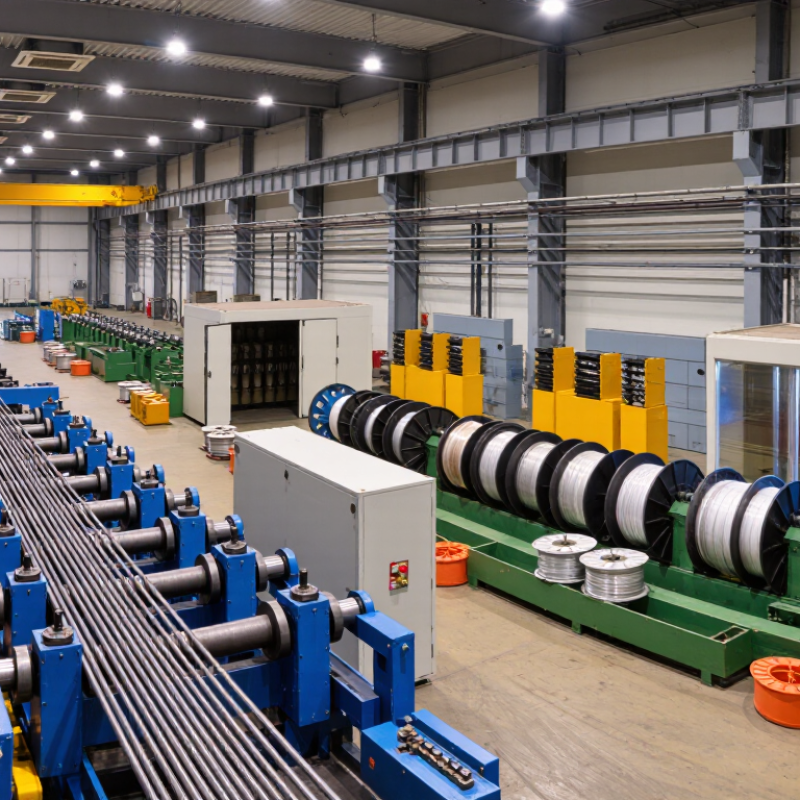
Drawn steel wire equipment reduces a steel rod to a smaller, more consistent diameter by pulling it through a series of dies. A payoff unit feeds the rod into the line, while guides keep it aligned. Before drawing, the surface may be cleaned and coated with lubricant. This helps limit friction and die wear. Small details matter.
Inside the drawing section, capstans pull the wire through progressively smaller openings. The operator adjusts speed, tension, and lubrication to suit the steel grade and target size. Poor control can leave scratches, uneven dimensions, or wire breaks. The take-up unit then winds the finished wire onto a spool or coil. Some lines also include cooling, inspection, or annealing equipment when the product requires it. Heat changes things.
In practice, the equipment is only part of the result. Die condition, rod quality, and setup choices matter too. A line may appear efficient on paper, yet struggle with a particular wire size. Operators often need to check sample measurements and surface finish during production, then make careful adjustments. These checks help catch problems before a full coil is completed.
How Steel Wire Drawing Machines Reduce Wire Diameter
A steel wire drawing machine reduces diameter by pulling rod through a hardened, converging die. The die compresses the wire as it passes; a motorized capstan then pulls and collects it under controlled tension. Each pass changes the cross-section, not just the visible width. For example, reducing an 8.0 mm wire to 6.8 mm removes about 27.8% of its cross-sectional area, calculated from circular dimensions. Small changes matter.
Most production lines use several dies in sequence because each reduction raises tensile stress and work hardens the steel. Lubricant at the die helps limit friction and heat, while guides and take-up controls reduce scratches and uneven tension. The ASM Handbook’s metalworking coverage describes drawing as a controlled bulk-forming process; actual pass limits depend on steel grade, die geometry, lubrication, and equipment. The scale is substantial: World Steel Association’s World Steel in Figures 2024 reports roughly 1.9 billion tonnes of crude steel produced worldwide in 2023. Real lines are less tidy: die wear and lubricant changes can make nominally identical passes behave differently, so operators check diameter and surface finish between stages.
What Are the Top Types of Drawn Steel Wire Equipment? - How Steel Wire Drawing Machines Reduce Wire Diameter
Steel wire drawing equipment pulls wire through one or more dies with progressively smaller openings. The die reduces the wire’s cross-sectional area; the machine supplies and controls the pulling force, speed, lubrication, and take-up. Equipment categories can overlap—for example, a multi-pass line may use dry or wet lubrication.
| Equipment type | Typical configuration | How diameter is reduced | Common uses and considerations |
| Rod breakdown machine | Usually a continuous, multi-die line designed for drawing larger feed rod into smaller wire. | The wire passes through a sequence of dies, each with a smaller working opening. Capstans pull and transfer the wire between passes. | Used as an upstream stage in steel wire production. The pass schedule, die condition, and lubrication must suit the steel grade and incoming rod. |
| Intermediate wire drawing machine | A single-pass unit or multi-pass line used between breakdown and final drawing stages. | One or more dies reduce the wire in stages. Each die changes the wire’s cross-section while drawing tension carries it through the die. | Can prepare wire for products such as fasteners, mesh, or further fine-wire drawing. The required number of passes depends on the starting and target sizes and material properties. |
| Fine-wire drawing machine | A precision line with small dies, controlled tension, and take-up suited to fine wire. | Successive fine-drawing passes bring the wire to its target diameter. Accurate alignment and stable tension help maintain dimensional consistency. | Used where smaller diameters and consistent wire quality are needed. Die wear, lubrication, and break detection become especially important as wire gets finer. |
| Dry drawing machine | A drawing setup that uses a dry lubricant, commonly applied as a powder or coating at the die. | The die performs the reduction; dry lubricant helps limit friction and wear as the wire passes through it. | Common for many steel wire operations. Lubricant choice and die-box maintenance are important; the equipment can be arranged for one or multiple passes. |
| Wet drawing machine | A machine with dies and wire running in, or supplied with, liquid lubricant. | The wire is pulled through dies while liquid lubricant supports lubrication and heat removal at the drawing interface. | Often selected for fine-wire applications requiring effective cooling and lubrication. Fluid condition, filtration, and temperature need to be managed. |
| Single-block or bull-block machine | A drawing die paired with a large capstan that pulls and collects the drawn wire in coils. | A wire length is drawn through a die and wound around the block. The block provides the pulling action and stores the processed wire. | Useful for single-pass operations or particular drawing stages. Suitable applications depend on the wire size, coil handling, and required production arrangement. |
Area reduction per pass: For round wire, the percentage reduction in cross-sectional area can be calculated as [1 − (final diameter ÷ starting diameter)2] × 100. Actual pass schedules depend on the steel grade, incoming condition, die design, lubrication, and equipment limits.
Main Types of Steel Wire Drawing Machines
Main Types of Steel Wire Drawing Machines
Steel wire drawing machines reduce a rod’s diameter by pulling it through one or more dies. Single-block machines draw wire through one die at a time and suit smaller production runs or straightforward size changes. Operators can inspect each pass closely. That control matters.
Multi-pass continuous machines use several dies in sequence, with capstans between them to manage wire speed and tension. They can produce long lengths efficiently, but die alignment and lubrication need careful attention. A small mismatch may cause breaks or uneven wire. Production speed is not the only measure.
Dry drawing machines use lubricating powder around the dies and are commonly used for larger wire sizes or early reduction stages. Wet drawing machines keep the dies and wire immersed in liquid lubricant, helping reduce heat and friction during fine-wire production. Bull-block machines, by contrast, draw wire onto a large rotating drum and are useful for heavier reductions or batch work.
In practice, categories can overlap, so the material, target diameter, and finish should guide equipment choice. A machine’s label alone says little about its condition or suitability. Check the line’s actual speed range and maintenance history before relying on a specification sheet.
Auxiliary Equipment Used in Steel Wire Drawing Lines
What Are the Top Types of Drawn Steel Wire Equipment?
Auxiliary Equipment Used in Steel Wire Drawing Lines
Auxiliary equipment helps a drawing line feed, clean, lubricate, cool, and collect wire reliably. A payoff reel supplies the rod, while guides and straighteners help control its path before the dies. A poorly aligned guide can cause uneven entry or surface marks. Small details matter.
Cleaning units remove scale and residue before drawing. Depending on the incoming material, these may use brushing, mechanical descaling, or rinsing. Lubrication boxes then apply drawing powder or liquid, reducing friction as the wire passes through each die. The right setup depends on the wire material, diameter, and process conditions; one arrangement will not suit every line.
Cooling systems manage heat around the dies and capstans, while tension controls help keep the wire moving consistently. A take-up spool or coiler gathers the finished product without sharp bends. Operators should also check guards, sensors, and emergency stops during routine inspections. Keep it steady. These components cannot compensate for worn dies or poor setup, and maintenance intervals may need adjustment as production conditions change.
How to Choose Equipment for Different Wire Products
Choosing drawn-steel-wire equipment starts with the finished wire, not the machine catalogue. Low-carbon wire for nails or mesh often suits high-speed dry drawing with several dies and a dependable take-up. Spring wire needs tighter diameter control, careful lubrication, and a drawing schedule that limits surface damage. Stainless wire may benefit from wet drawing, which helps manage heat and die wear. For very fine wire, check whether the line can hold tension steadily; a small fluctuation can spoil a long coil.
World Steel Association reported 1,882.6 million tonnes of crude steel production in 2024. This is useful context for the industry’s scale, but it is not a measure of wire demand or a sizing formula for drawing lines. Match equipment capacity to your own product mix, target diameter, reduction per pass, and changeover frequency. Ask suppliers for trial results using your actual rod and lubricant. I would not choose from rated speed alone; real operating conditions can be less tidy than a brochure suggests.
Tips: Start with the wire. Record incoming rod chemistry, diameter, and surface condition. Compare dry and wet drawing on the same sample, then inspect the wire for scratches and ovality. Check die availability, annealing needs, and spool size before ordering. Leave room for adjustment; the first setup may not be perfect.